Showing posts with label designing and developing digital outcomes. Show all posts

Wednesday, 6 March 2019

DigiCreate - DDDO PO3

DIGCREATE - DDDO PO3

Graphic novels are a great place to start Integrating English and Digital Technologies together, as well as integrating Art concepts.

The following resources have been made available for Teachers and Schools. In the teacher's guide they there are pages of a practising artist talking about the different tools and techniques that they use to develop the novels.

Getting students to develop content, ideas through an English lesson and then using ipad's, drawing tablets, to draw there own characters and place them into an environment that could be created as part of their art class for backgrounds using different art techniques. The focus was a single page as part of their work.

Here is part of the design and planning of one of the students work that was developed as part of this integrated module at Hobsonville Point Secondary Schoo
20150424_095209.jpg

Graphic Novels

Graphic novels are a genre of literature that present their narrative primarily through pictures. Graphic novels are an ideal way of encouraging reluctant readers to engage with a detailed extended text. 
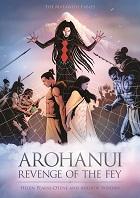
Arohanui: The Revenge of the Fey cover

Arohanui: Revenge of the Fey 

This resource is part of the graphic novel series The Matawehi Fables. It tells the magical tale of two iwi: one thriving, the other starving and desolate, forced to enter in to a bargain to secure survival and a future for their people.
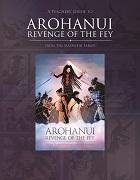
Arohanui: Teachers Notes cover

Arohanui Teacher Notes

This teacher resource aligns to the graphic novel Arohanui: Revenge of the Fey. 
It is designed to help teachers use the graphic novel to engage learners and help them develop their skills across all areas of literacy.  The resource provides a basic and practical guide for teachers with a ‘how to’ focus on using graphic novels to support their literacy programmes.

Meariki: The Quest for Truth 
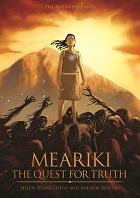
Meariki is a slave to the people of Ngāi Kūwai. When the daughter of the chief is kidnapped, Meariki is sent on a quest to rescue her. Along the way she meets some interesting characters. Ultimately Meariki discovers her true destiny.

Developing Historical Signage - DDDO PO3

History - WOTPOINT

One of the projects that students enjoyed has been to develop new signage for some of the areas around the community. This was a project that was developed around the integration of learning areas, Technology and Social Science, this involved them finding out information through their social sciences class, on an aspect of the history of the area. This enabled students to have an authentic context in which to learn and implement design principles. 


Learning Objectives (Social Science)
Learning Objectives (Technology)
  • To MAKE SENSE by understanding cultural diversity.
  • To MAKE SENSE by understanding the significance of biculturalism in New Zealand.
  • To FOCUS on interpreting resource material for validity, meaning and relevance.
  • To generate by producing a technological outcome
  • To refine by transforming materials to be fit for purpose


Using a variety of ideas from paper's past, as well as students developing their own inquiry into an aspect of the area.
While we are lucky at Hobsonville Point to have such a variety of history around us, from being an RNZAF base, also around us is the former pottery companies that existed, they loved the white clay of Onekiritea. 

Also using the https://www.heritage.org.nz/the-list site, as well as local historical knowledge to get students investigating their local history. Aspects of research, collecting images that are on the https://digitalnz.org/ project. As well as students going and taking their own images, an aspect of this is included at the bottom of the email around enabling priority learners.

Students looked at the buildings and areas that exist on the point and choose one from the list that was provided or one of their own suggestions. 

Students learnt how to do isometric drawings, as well as drawing sketches. They then took these into Google Sketchup to enable them to learn new tools and techniques in an unknown piece of software that they could then use to model up an idea in the future.


While we used the Auckland Design Guidelines, getting students to design and develop a sign that could be used to display the information. This highlighted to the students the new part of the progress outcome of the DDDO Progress Outcomes.

Opportunity for Priority Learners.
Outcomes involved students even creating their location through the use of Minecraft, working at below curriculum levels. But opportunities to build and develop content that could be used to incorporate into their design.
Also involved a student that is wheelchair bound to hook up a go pro to there wheel chair computer bracket for them to go out and take photos of their historical place to be able to incorporate their research and own images in their work.


Progress Outcome 3 used

In authentic contexts, students follow a defined process to design, develop, store, test, and evaluate digital content to address given contexts or issues, taking into account immediate social, ethical, and end-user considerations. They identify the key features of selected software and choose the most appropriate software and file types to develop and combine digital conten

Sunday, 17 December 2017

kite photography

Earlier this year a student posted up a photo of their kite aerial photography. This was something that was explored and developed on through the come fly with me project when they were trying to send up a weather balloon with sensors attached.

Through kickstarter this year a balloon mapping kit was made available https://www.kickstarter.com/projects/publiclab/kickstarter-gold-balloon-mapping-kits through the kickstarter also came a kite mapping kit as well. Since I am more likely to be not wandering around with a bottle of helium, the kite mapping kit is more suited.

I finally had time to try this out at our local park. I was amazed at how well it flew as well as how much string I still had on the reel.

I plan on doing a few more of these as time allows.

How might this be used within a project. Getting students to update the changes to our local orienteering map so we can have a map for our school.


Saturday, 2 December 2017

end of year thinking

It has come to the time of the year where I have been thinking about ideas for next year.

What type of projects could be offered to students to develop Designing and Developing Digital Outcomes?

Idea One

Thinking of a starter activity for the year, something that get students using vector based programmes to develop ideas. Using open source software, inkscape allows students to develop vector based images.

While I have bene interested in this type of idea for a year now, something around getting students interested in the hobsonville habits. I wish I had taken a photo yesterday of the sleeves of the year 8 students that came to school yesterday. There seems to be a history of badges with intermediate schools in the area.
How could we take this thinking and apply it in a different way.

We have a laser cutter...

https://www.kickstarter.com/projects/steamcrow/monster-scouts

Also the idea of badges, since we have a sewing machine that can embroider... and 3d printers... opportunities could be developed... this would require students to think broadly.


To be able to get students working towards the badges using an idea around evidence of working towards the habits and goals.

Second idea

The second idea is one around mapping. We have an ever changing point where we need to do some work to enable a physical education activity to take place.

Kite flying capturing of the point using go pro and public lab. https://publiclab.org/

To be able to knit the images together, public lab has a mapknitter website https://mapknitter.org/

This would link into complex digital media techniques to be able to develop this as it would require a range of different capturing methods to be used.
http://www.openorienteering.org/apps/mapper/

Third one

The third one relates to my last post which is around developing the circles, something that I have been thinking about and exploring, through research I have found https://graphicdesign.stackexchange.com/questions/37823/how-to-place-different-sized-circles-inside-a-shape/37852 which provides some good answers in how this could be developed.


Friday, 14 July 2017

Developing ideas for Design and Developing Digital Outcomes Progress Outcome 2

I have been thinking about this for a while, and have done some action to work on the ideas.
A couple of years ago I used the mindkits brainboards to develop the ideas of coding with some electronics. With this the arduino provides students with an understanding of how to program. So I have been thinking about this and what the next set of gear could be.

Now, the micro:bit is available. I managed to get two of these through sparkfun earlier in the term. The great thing about these is the matrix, as well as they have an accelerometer and compass.

Now, I received an email through the nzacditt network which
In case you hadn't seen this in the news: Code.org is giving low-income students a chance to learn how to code through a free course called “Computer Science Discoveries.” The yearlong course, unveiled this week at Code.org’s TeacherCon conference in Houston, will be taught by more than 800 teachers during the school year. It’s designed for students in grades 7-9 and teaches Web design, physical computing and game creation. Link to new article

The adafruit circuit playground is part of the course, now I have had an opportunity to look at and develop during the last day and I must say that I am impressed. a small board with a lot of grunt, the part I like is the opportunity for it to record data. This makes it a great start for Internet of Things opportunities.
Stick a battery pack on this and it can be used anywhere...

https://www.adafruit.com/product/3000

Now there is an updated version coming out, with some more sensors on it and a bit of reworked system, that allows for a few more languages to be used. I am more using this a gateway to electronics, something that can be easily adapted and developed, however as students learn about the sensors and what they can do, or can't do, then other alternatives need to be looked at and developed. 

How does this look in relation to the new digital technologies curriculum. Is it Computational Thinking, or is it Designing and Developing Digital Outcomes.

It is something that I find rather difficult to put in a box for now, the guidance just isn't there. 
Mind you, I have not given what the purpose of the the idea is.

With some thought on what the purpose of the outcome could be:
Develop a solution that can record a runners temperature, and what effect the run has on a person using an accelerometer. Graph the results of this. 

It is only then that I look at this is around Designing and Developing Digital Outcomes, rather than Computational Thinking. 

  • Given some parameters/criteria and tools and/or techniques they are able to make decisions (largely independently) about creating, manipulating, storing, retrieving, sharing and or testing content (developed for a specific purpose) within a fundamental system.
  • Understanding the particular roles of components in a fundamental input, process, output system and how they work together.

Students could then talk about how they could show a couple of other aspects of this, talking about better storage opportunities through a sd card, as well as being able to record longitude and latitude through a gps receiver.
  • Understanding that inputs are transformed into outputs within a fundamental system and the “control” role that humans have in this. 
  • Purposefully use an increasing range of applications (software and file type).
Some may be thinking you have aimed for the wrong progress outcome with this, considering no student currently has any progress outcomes reported against them, I think Progress Outcome 2 for Designing and Developing Digital Outcomes at year 9 and 10 is a good place to start. Considering Progress Outcome 3 is Given some parameters they are able to make decisions (largely independently) about the best tools/ techniques to solve the problem.  
How can they make the decisions when they haven't been given the learning to support those yet?

While other may look at the Computational Thinking and look at combining these, I feel they could lose opportunities for evidencing there learning.